On a summer morning, a familiar argument plays out in many Indian cities. A family says the bill is too high because water supply was irregular. The utility points to meter readings. The local office checks a complaint register. Someone pulls up a map. Another person looks at a control-room screen. The conversation goes in circles because the information sits in different places and rarely tells a single, clear story.
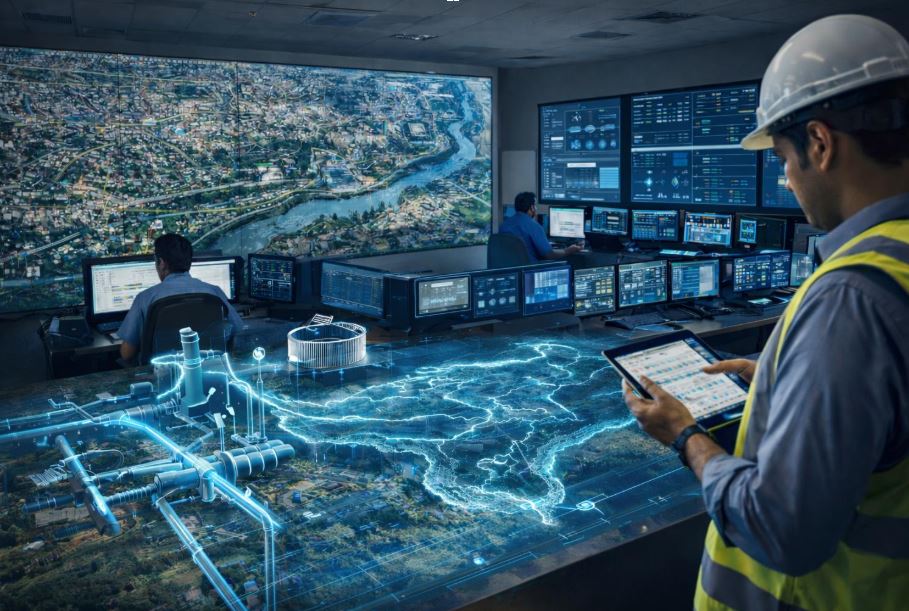
This is the reality behind many “smart water” upgrades. Cities are adding sensors and building monitoring dashboards. They can track pressure, pump status and flow better than before. But the tools often work like warning lights. They show what is happening. They do not always explain why it is happening, or what action will prevent the next disruption.
Singh’s background helps explain his focus on practical outcomes. He is a Carnegie Mellon University graduate and has also pursued a master’s degree in construction management, alongside working with US-based utility programmes, including multiple Lead Service Line Replacement projects delivered in recent cycles. He also publishes research on digital twins and AI in the water sector. This blend of engineering, delivery and research is why he describes digital twins as tools that should reduce disruptions on the ground, not just add more data to screens.
Ayush Singh, a civil and environmental engineer whose research focuses on digital technologies for water infrastructure, says this is where India’s water modernisation is getting stuck. He argues that many deployments still resemble separate islands of data, with GIS maps on one side, SCADA screens on another, and maintenance records elsewhere. The result, he says, is that utilities become better at reacting faster, but not necessarily better at preventing problems early.
Digital twins are being pitched as a way out of that trap. Put simply, a digital twin is a live computer model of a real system. It does not just display readings. It tries to behave like the network itself, using data and models together. In practical terms, it can help operators test scenarios before taking action. It can help identify whether a pressure drop is a short-term demand issue, a pump operating inefficiently, or the early sign of a leak that will soon become a burst.
India already has early examples that show what this approach can look like. In Ayodhya, a digital twin has been used to support decisions around a pressurised water supply network, including how changes in pumping and pressure management affect performance. The value of such work is not the graphics on a screen, but the ability to guide day-to-day operational choices with better confidence.
There is also a larger, more ambitious effort underway at the basin level. IIT Delhi is working on a digital twin of the Ganga basin, aimed at simulating river behaviour and environmental impacts. While this is not the same as a city water distribution network, it signals the direction of travel. India is beginning to use virtual models not only for visibility, but for planning and testing decisions in complex water systems.
Singh’s work also highlights why this matters for utility finances. When a system relies mainly on reactive maintenance, costs rise quietly. Pumps run inefficiently, leaks persist longer than they should, and asset life can shorten because failures are addressed late. A decision-grade system, he says, can support maintenance based on condition and risk rather than fixed schedules, reducing emergency work and improving reliability.
Still, digital twins are not a magic switch. Many Indian utilities face basic challenges such as incomplete asset records, fragmented data ownership, and limited technical capacity. Trust is another factor. People are more likely to accept decisions and billing outcomes when utilities can clearly explain what happened and why. Technology that remains opaque can create more suspicion, not less.
That is why Singh argues the next phase should be steady and practical. Not every pipe needs a sensor on day one. The bigger need is integration, so that maps, operations data and field records speak to each other. Without that, dashboards remain dashboards, no matter how modern the screens look.
India’s water challenge is getting harder with climate stress, urban growth and ageing infrastructure. Monitoring tools have helped, but citizens judge success in simple terms. Water that comes when expected. Water that looks and smells safe. Complaints that do not take weeks to resolve. Digital twins will only matter if they help cities deliver that everyday stability, not just better charts in a control room.